 English
 Français
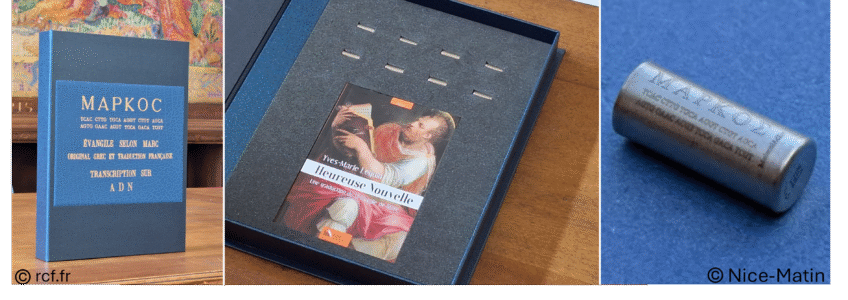
An Extraordinary State Gift
During his visit to France, Pope Leo XIV received an unprecedented gift from the Presidency of the Republic: the Gospel according to Mark, in ancient Greek and French, encoded in synthetic DNA and encapsulated by Imagene. This project was carried out in partnership with Pascal Barbry (CNRS Institut de pharmacologie cellulaire et moléculaire / PEPR MoleculArXiv (1))).
Why use DNA in a capsule to store information intended to last for millennia?
The appeal of DNA as a data storage medium lies first and foremost in its extraordinary information density: in theory, just a few grams of DNA would be enough to contain all the digital data produced worldwide over the last year. Furthermore, data in this form is long-lasting because the molecule can remain stable at room temperature—provided it is protected from oxygen, water, and other atmospheric pollutants that inevitably lead to its degradation.
Imagene’s Solution: Protection Against Degradation Factors
This is precisely where Imagene technology comes into play—a technology that has been developed and validated for nearly 30 years. A study recently published by Coudy et al. in the journal PLOS One estimates the half-life of 150-bp fragments (a size corresponding to the track width of the encoded information) under these conditions to be 38,000 years (2). Thus, thanks to their hermetic seal, DNAshell capsules keep DNA protected from degradation factors, enabling essentially indefinite preservation over human timescales.
A choice consistent with the text’s symbolic significance
The choice of these capsules to preserve the Gospel according to Mark is no accident. A text that has been passed down for nearly 2,000 years deserved a medium capable of, in turn, spanning the millennia. The convergence of an ancient document and cutting-edge technology gives this gift a special dimension: that of continuity, between the expression of a word and its transmission over the long term.
To enable the text to be read from the DNA, it is accompanied by a decoding guide detailing the method for reconstructing the text encoded in the capsules (3).
(1) https://pepr-molecularxiv.fr/
(2) https://doi.org/10.1371/journal.pone.0259868
(3) https://entrepot.recherche.data.gouv.fr/dataset.xhtml?persistentId=doi:10.57745/5P5PNA